Casting, Coding, Creating: Matter + Code, A New Fall Seminar
August 24, 2025
We are excited to announce Gibbs Collective Creating: Matter + Code, this fall semester seminar offered as part of the American School Design Build creating making initiative at the OU Gibbs College of Architecture. This seminar pushes the boundaries of architecture, industrial design, technology, and fabrication, preparing students to work fluently across disciplines as both digital thinkers and hands on makers. The course is designed to immerse students in a rigorous process of design and fabrication, where digital modeling, material testing, and iterative prototyping become central methods of inquiry. Through focused projects and technical skill-building, students will learn how to navigate between concept and execution, balancing creativity with precision. By connecting architectural logic with industrial design experimentation, the seminar aims to equip students with not only the technical fluency but also the confidence to innovate and craft meaningful, real-world work.
Above image: Jewelry designs by Nervous System Studio
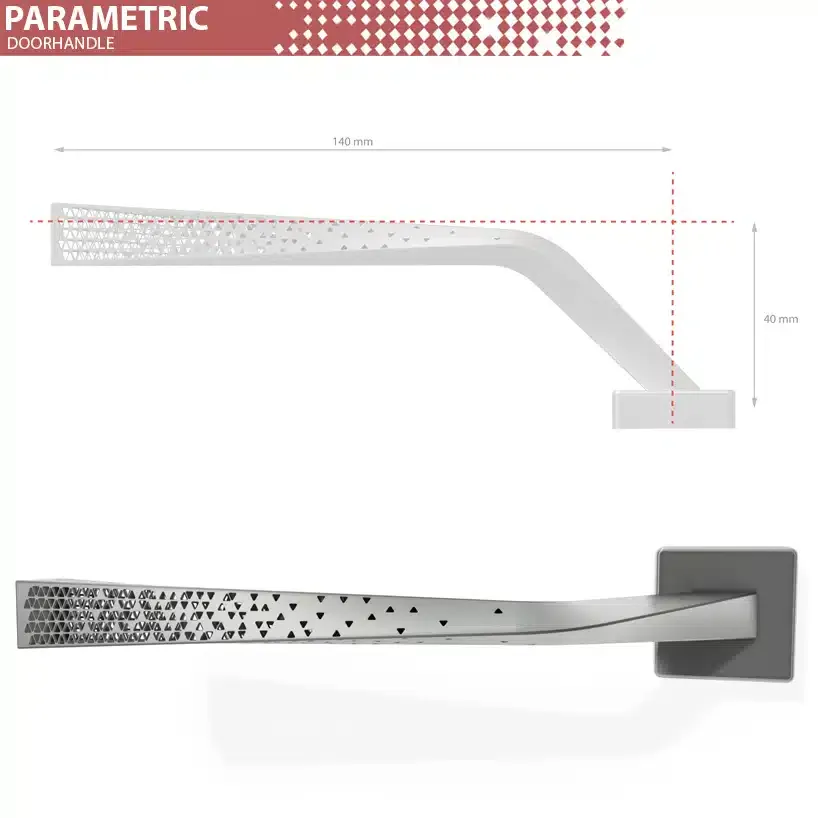
Right image: Parametric door handle by Smeding Saul
Ken Marold
Instructor & Studio Coordinator, American School Design Build
Current Courses: American School Design Build Studio, Gibbs Collective Creating Seminar: Digital + Material Strategies, Methods 2: Patterns in Architecture

Course Details
Gibbs Collective Creating is an immersive, ever-evolving design and fabrication seminar. Students will design, prototype, and fabricate a series of original projects that explore the technical boundaries between architecture, industrial design, and digital fabrication.
This year’s focus, Digital Fabrication Strategies + Technology, emphasizes that as architects and designers today, students must be fluent across disciplines—a digital thinker, a maker, a storyteller, and an inventor. The work students produce—whether a product line, a light-filtering surface, or an adaptive system—extends beyond functional artifact. It is the result of deep thinking about form, material behavior, fabrication, and technical precision.
This seminar foregrounds craftsmanship, authorship, and innovation in equal measure. Students will not only learn advanced tools like Rhino, Grasshopper, Arduino, Processing, and ChatGPT, but will apply them through rigorous hands-on workflows, including laser cutting, 3D printing, lost wax casting, LED integration, and full assembly. These fabrication processes are not afterthoughts—they are central to how ideas take shape, evolve, and gain precision. Through iteration and material testing, students will learn to embrace constraint as a generative force and translate digital models into tactile, resolved, real-world designs.
Students will build a portfolio of resolved, high-quality prototypes that reflect not only technical skills, but also personal design language and conceptual clarity. The course underscores the value of working across disciplinary lines. Fabrication logic—including joinery, digital form generation, casting, electronics integration, and spatial light behavior—will be explored through the lens of architectural and industrial systems thinking.
Whether student interests lie in digital craft, interactive prototyping, product-making, or experimental surface design, this seminar offers the tools and framework to prototype meaningful, real-world work. By the end of the course, students will leave with sharper digital and fabrication skills, a more versatile design process, and a deeper understanding of how innovation happens at the intersection of disciplines—equipped to take on roles that demand both architectural vision and industrial design fluency.
The seminar emphasizes precision, iteration, and material experimentation—skills central to turning digital ideas into real-world prototypes.
Course Objectives
By the end of this course, students will be able to:
-
Develop parametric models in Grasshopper that translate cleanly to fabrication at both object and surface scales
-
Evaluate and select appropriate materials and tools for specific fabrication goals
-
Understand the mechanics of joinery, layering, lost wax casting, and LED integration
-
Use AI tools (e.g., ChatGPT, GitHub Copilot) to support script generation and iteration
-
Communicate process, concept, and fabrication logic through diagrams, drawings, and renderings
-
Build high-craft physical prototypes that integrate both spatial and visual logic
-
Explore historical and contemporary examples of architects and designers working across scales as precedents for fluid design thinking
Students leave with a toolkit of parametric design, fabrication, and documentation skills ready for professional application.
Projects Overview
This single semester seminar is organized around three sequential projects. Each project builds on the previous one, moving from small-scale industrial design to spatial light performance to interactive or adaptive systems.
PROJECT 1 // Jewelry Line OR Architectural Hardware Line:
Students develop a coherent line of small-scale artifacts, either jewelry or architectural hardware. They model multiple design variants, explore proportion, ergonomics, and tectonic expression, and iterate through 3D printing to evaluate fit, tolerance, and finish. There will be one final casting for the line, and all iteration is completed through 3D printing so refinements can be made quickly and accurately. Final deliverables include technical drawings, exploded assemblies, fabrication-ready files, and a concise presentation of process, drawings, and final artifacts.
PROJECT 2 // Backlit Surface or Light Filter with Arduino and LED Integration:
Students design and fabricate a static surface that modulates light through pattern, layering, and material translucency, while integrating Arduino-controlled LED lighting to create programmable light behavior. Using Rhino and Grasshopper, they generate and test parametric patterns, then fabricate with laser cutting and material layering. Deliverables include the fabricated panel, wiring diagram, control code, technical drawings, and a short video documenting light performance.
PROJECT 3 // Interactive Wearable Object, Interactive Industrial Design Object, Kinetic Object, or Adaptive Surface:
Students define and execute an original project that brings interactivity, movement, or adaptation into focus. Concepts may take the form of wearable objects, interactive industrial design objects, kinetic mechanisms, or adaptive surfaces. Students integrate sensors, microcontrollers, or actuation, and resolve the project as a functional prototype with clear documentation. Deliverables include the fabricated prototype, interaction diagram, control code, technical drawings, and a short video demonstrating performance.
Across three sequential projects, students move from precision object-making to spatial light performance to adaptive interactivity—gaining a full spectrum of digital and material skills.
Skills Highlights
-
Fluency in Rhino and Grasshopper with a focus on parametric control and repeatable workflows
-
Translation of digital models into fabrication-ready files for laser cutting, 3D printing, and lost wax casting
-
Planning for tolerance, shrinkage, finishing strategies, and safe assembly
-
Integration of Arduino electronics for LEDs, sensors, and actuation
-
Professional project presentation through drawings, photographs, diagrams, video, and written summaries
The seminar instills both technical fluency and conceptual vision, shaping designers who can lead projects from concept to fabrication.
Professional Orientation
This seminar trains students to define a problem, test ideas rapidly, and deliver something functional, beautiful, and buildable. Students will practice architectural systems thinking, and will learn how to manage complexity while maintaining conceptual clarity. The aim is to help students develop a personal design language and a repeatable process they can carry into practice.
Follow along for project highlights during the semester as students bring ideas to life at the intersection of digital modeling, material craft, and fabrication logic.